

Chicagoland depends on infrastructure to function. Roads, bridges, utilities, rail, and transit systems support how people move, how businesses operate, and how communities stay connected. When these systems are maintained and improved, the region stays competitive. When they fall behind, the impacts show up quickly through congestion, delays, safety concerns, and rising costs.
This is why continued investment in infrastructure matters for Chicagoland in real, measurable ways.
Infrastructure Supports a Major Economic Hub
The Chicago region remains one of the largest transportation and logistics centers in North America. National freight rail lines, interstate highways, waterways, and air cargo routes all converge here. That role depends on infrastructure that can handle volume, weight, and constant use.
Transportation efficiency affects far more than travel time. It influences supply chains, workforce mobility, and the reliability businesses need to operate day after day. As infrastructure conditions decline, delays increase, operating costs rise, and reliability suffers across industries that depend on the predictable movement of people and materials.

Transportation Investment Keeps Commerce Moving
Transportation projects support the systems that keep Chicagoland working.
Roadway and corridor improvements help maintain access to major routes and reduce long-term maintenance costs by addressing issues before they become failures. Planned upgrades limit disruptions, reduce emergency repairs, and allow systems to be designed for future demand rather than patched after breakdowns occur.
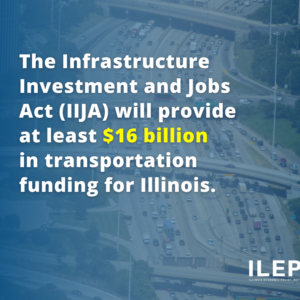
Federal investment has played a major role in advancing this work. Under the Infrastructure Investment and Jobs Act, Illinois is projected to receive approximately $17.8 billion in federal infrastructure funding over five years. Of that total, roughly $9.8 billion is dedicated to roads and bridges, with an additional $1.4 billion specifically allocated for bridge repair and replacement. These funds support resurfacing, reconstruction, and safety improvements across state, county, and municipal networks.
This level of investment allows agencies to plan proactively, coordinate roadway and utility improvements, and address aging infrastructure before it fails. Proactive investment strengthens the transportation network businesses rely on every day and supports consistent movement across the region.
Infrastructure Projects Create and Sustain Jobs
Infrastructure investment supports employment across the region.
Construction projects create direct work for skilled trades, operators, laborers, engineers, and project managers. Beyond the job site, dependable infrastructure supports long-term employment in industries that rely on reliable transportation and utility systems.
Illinois’ multi-year infrastructure program, totaling more than $50 billion, is expected to support tens of thousands of jobs statewide. Well-planned projects also strengthen the local supply chain by sourcing materials, services, and equipment from businesses throughout the region.
Phasellus gravida ullamcorper luctus. Donec condimentum tortor sollicitudin, venenatis odio ac, rhoncus nulla. Praesent condimentum, mi ut tempus semper, est libero volutpat elit, at commodo magna orci malesuada erat. Nunc pretium sodales urna, eu convallis metus dictum vitae.
Reliable Infrastructure Improves Everyday Efficiency
Infrastructure performance shows up in daily operations for residents and businesses alike.
Well-maintained roads reduce vehicle wear through consistent pavement thickness, proper base compaction, and smooth riding surfaces. Vehicles experience less vibration, fewer suspension impacts, and reduced tire damage, lowering long-term maintenance costs for commuters, fleets, and municipalities.
Roads built and rehabilitated to current standards improve safety. Clear pavement markings, improved sightlines, corrected cross slopes, and properly designed intersections reduce conflict points and improve braking performance, particularly during wet and winter conditions.
Targeted roadway improvements such as turn lanes, signal optimization, and intersection realignments relieve congestion and improve traffic flow. Commute times shorten and become more predictable, which matters to both workers and businesses.
Drainage systems play a critical role in pavement performance. Moving water away from the roadway structure prevents infiltration into the base and subgrade, reducing freeze-thaw damage, potholes, and premature failure. Fewer unplanned closures and emergency repairs follow.
Upgraded underground utilities reduce service interruptions and provide the capacity needed for residential, commercial, and industrial growth. Municipalities and developers depend on systems that can meet demand without frequent failures.
Public Investment Encourages Private Development
Development follows infrastructure.
Road access and capacity determine whether sites can be reached safely by construction equipment, deliveries, employees, and future users. Adequate access is often required before projects receive approvals. Without it, additional costs and delays follow.
Modern, properly sized utilities remove one of the largest barriers to development. Projects move faster when developers are not required to fund major off-site utility extensions or upgrades. Reliable water, sewer, and storm systems also reduce operational risk once a project is complete.
Infrastructure investment improves site readiness by addressing grading, drainage, and utility constraints that can limit development potential. This is especially important for redevelopment and infill projects throughout Chicagoland.
From a financing perspective, sites served by stable transportation and utility systems present lower long-term risk. Predictable operating conditions make projects more viable and easier to finance.
Long-Term Planning Reduces Future Costs
Infrastructure systems have known service lives.
When routine maintenance and timely rehabilitation are delayed, small issues compound. Surface cracking allows water to penetrate pavement structures, weakening the base and subgrade and accelerating deterioration.
As conditions worsen, repairs shift from planned work to emergency response. Emergency repairs require rapid mobilization, temporary traffic control, premium labor rates, and short-term fixes that rarely address underlying structural issues. Costs increase, disruptions multiply, and service life shortens.
The same pattern applies underground. Aging utility systems that are not replaced on schedule are more likely to fail unexpectedly, causing service interruptions, roadway damage, and costly emergency excavation. Coordinated planning allows roadway and utility work to be completed together, reducing repeat disruptions and restoring pavement once instead of multiple times.
Addressing infrastructure at the right point in its lifecycle extends service life, reduces emergency closures, and lowers total ownership costs.
Infrastructure Investment Is a Regional Responsibility
Infrastructure functions as a connected system, not a collection of isolated projects.
Roadways, water systems, storm infrastructure, and transit corridors cross municipal and county boundaries. A bottleneck or failure in one location affects traffic flow, reliability, and safety well beyond that area.
Workers travel across municipal lines to reach job sites, industrial parks, offices, and distribution centers. Businesses depend on regional access to labor, suppliers, and customers. When infrastructure conditions vary widely between jurisdictions, inefficiencies increase and operating costs rise.
Regional coordination allows projects to be sequenced effectively, reduces repeated disruptions, and aligns roadway and utility improvements. This approach leads to better use of public funds and longer-lasting results.
Infrastructure performs best when it is planned, funded, and maintained as a shared regional system.
Infrastructure investment shows up in practical ways. It affects commute times, freight movement, operating costs, and whether businesses choose to stay and grow in the region.
At PT Ferro, we see those impacts firsthand. Our work supports the systems that keep our communities moving today and positioned for the future.
